
Arrest Warrants in Rogers County
Oklahoma law spells out how an arrest warrant gets issued. Under Title 22 §22-171, a verified complaint goes to a magistrate, and if the magistrate finds an offense occurred and reasonable ground exists to believe the accused committed it, a warrant may issue. Sections 22-161 and 22-162 name the judicial officers who may act as magistrates. That is the machinery behind every Rogers County arrest warrant. For an actual lookup, a few offices carry the weight. The Rogers County Court Clerk, OSCN, and the Sheriff's Warrant Division are the main county routes. A municipal case belongs to the city court. Federal matters go to the Northern District of Oklahoma.
Complaint, Oath, Magistrate, Probable Cause
Four terms do most of the work in this process. A complaint states the alleged offense. A verification, made by oath or affirmation, supports the filing. A magistrate then applies the statutory probable-cause standard. Once the warrant issues, an authorized officer may serve it. Keep in mind that the public record may show nothing more than a docket event, and later entries for appearance, bond, recall, or quash can change what the Rogers County file looks like over time. For deeper background on magistrate review, the Oklahoma Court of Criminal Appeals decision 2023 OK CR 18 is useful legal context for how that review works.
Plain meaning: Probable cause is the legal basis used at the warrant stage.
What a Rogers County Arrest Warrant Contains
You can learn a lot from a blank field list. A Rogers County warrant form shows its structure without private names, addresses, birth dates, or photos. The public portal may display fewer fields than the original document.
| Issuing court | The district, municipal, or federal court with authority over the case. |
|---|---|
| Case and warrant number | Two identifiers that may differ, such as ROGERS-ARREST-WARRANT for a blank example. |
| Complaint or charge | The public category or charging reference, subject to redaction and sealing. |
| Issue date | When the court authorized the process, not a current-status guarantee. |
| Service or return | An officer’s execution or attempted-service record, which may not be fully public. |
| Bond or appearance | A case-specific instruction controlled by the court. |
| Recall or quash | A later court action that should be confirmed by a docket event or clerk response. |
Why a Public Result May Be Missing
A missing result on OSCN does not mean nothing exists. OSCN searches cases and docket events, not every law-enforcement warrant field. A blank screen can come from picking the wrong court, a municipal or federal matter, a brand-new entry, a sealed record, or an interface that simply does not expose the document. The Rogers County Sheriff's Warrant Division publishes no full name search either. So work the angles. Re-run the search with the exact case number and Rogers County selected. If that fails, call the Court Clerk at 918-923-4961. Reach the Sheriff's Warrant Division at 918-342-9798 only for service or routing questions. For a defined historical record, file the county Open Records form and ask for the redacted public portion.
How Arrest Warrants Are Served
Service depends on which agency holds the warrant. The Rogers County Sheriff's Warrant and Transportation Division serves county warrants and manages holds and transports. City police or a marshal may serve a municipal warrant. A federal warrant runs through the federal court and the U.S. Marshals. Service, booking, bond, and court status are separate events.
| Matter | Possible serving route | Status authority |
|---|---|---|
| Rogers County District Court | Rogers County Sheriff or authorized law enforcement | Court Clerk and issuing court |
| City ordinance case | City police, marshal, or authorized officer | Municipal court |
| Civil process or body attachment | Sheriff Civil Processes or authorized officer | Issuing civil court |
| Federal case | U.S. Marshals and partner agencies | Federal issuing court |
Arrest Warrant Versus Summons and Bench Warrant
The three papers get confused easily. A summons directs a person to appear and carries no immediate arrest command. A bench or FTA warrant usually follows a missed court obligation. An arrest warrant follows the complaint and probable-cause path described above. The source document and the issuing court control how a Rogers County case is classified.
| Process | Starting event | Public question |
|---|---|---|
| Summons | Notice to appear or respond | What date and court must be followed? |
| Bench or FTA warrant | Missed appearance or authorized noncompliance | Is a new date, motion, or hearing required? |
| Arrest warrant | Verified complaint and magistrate review | What court controls bond, appearance, or recall? |
The Sheriff Serves, the Court Controls Status
The Rogers County Sheriff may receive, serve, hold, or transport on a county warrant. A service employee cannot unilaterally recall a court warrant, though. The Court Clerk is the county route for docket, payment, court-date, and recall questions. The Sheriff's Civil Processes page also states plainly that the office handles civil papers and gives no legal advice.
Rogers County Court Clerk
200 S Lynn Riggs Blvd., Claremore
918-923-4961
Warrant / Transportation Division
County service and transport routing
918-342-9798
What a Blank Form Can Show
OCCA Form 13.17e is a blank municipal cost-arrest-warrant form, and it teaches by example. It shows how a public document can hold an obligation, hearing language, a command, a service return, and court fields without exposing any real person's record. Its $100 remittance example and its 72-hour hearing protection are form details only. They are not a Rogers County fee schedule or a universal bond rule. Treat the form as a lesson in structure. Then ask the local court for the current amount, the hearing date, or the recall procedure that applies to a live case.
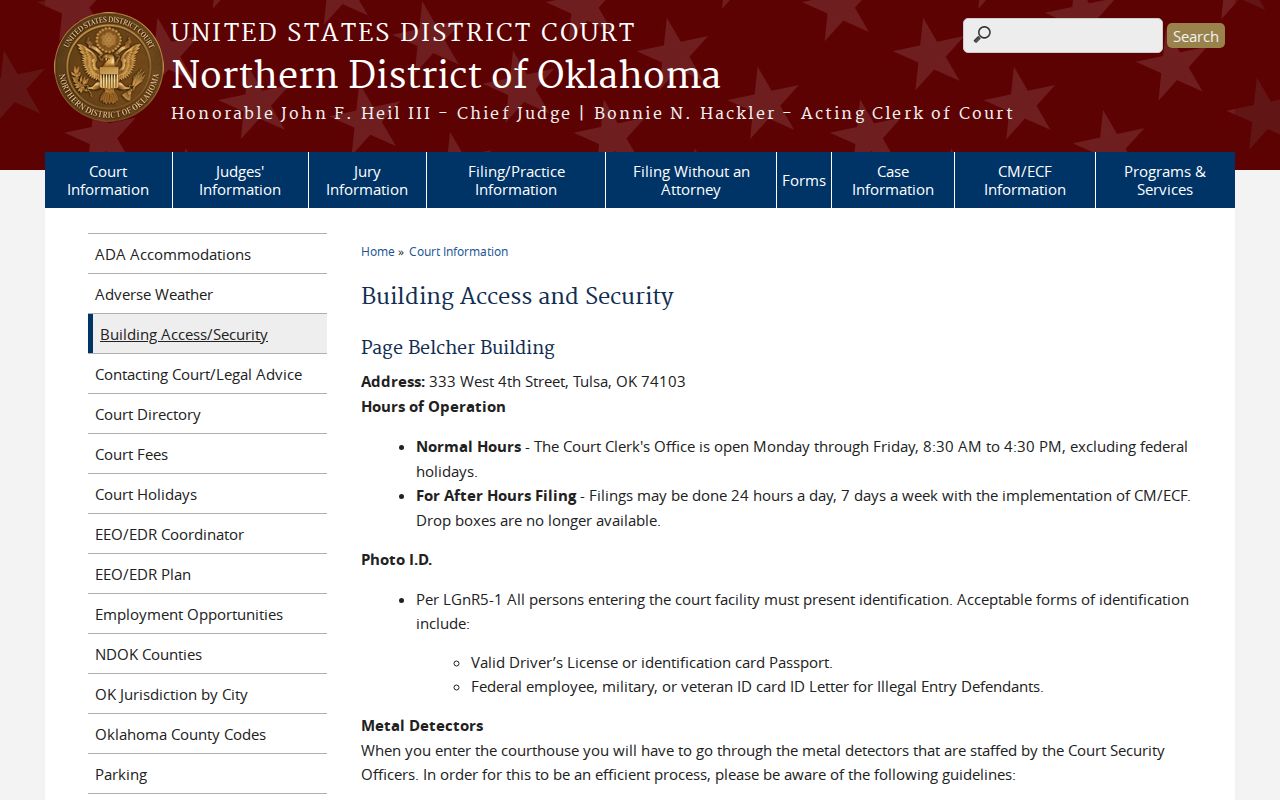
The federal building page is a useful visual reminder that federal access rules are separate from county procedures.
When a Federal Warrant Changes the Route
Rogers County sits inside the Northern District of Oklahoma. A federal arrest-warrant question therefore leaves the county system entirely. The Northern District clerk can be reached at 918-699-4700, and the U.S. Marshals Service at 918-200-0600. PACER is the federal docket tool, though it may require registration and fees, and sealed filings may stay hidden. No county Sheriff page can answer a federal docket question. Read the court caption before choosing an office. A county case in Claremore, a city citation in Catoosa, and a federal case in Tulsa can involve different records even when the person lives in Rogers County.
What to Do If There Is an Arrest Warrant
Confirm the basics first. Get the issuing court, the case number, the warrant type, and the current status. Then ask whether an appearance, surrender, bond, or motion is required, and where the person should report. The Rogers County pages publish no universal walk-in rule, no current bond schedule, and no guaranteed same-day hearing.
Before acting: Speak with a qualified attorney when detention, extradition, probable-cause issues, or a court filing may be involved. Ask the court how recall or quash will be recorded.
Keep the receipt after any payment, appearance, or surrender. Ask for the docket event or clerk confirmation that states what changed. A Rogers County Sheriff service record and a court recall are not the same event.